
锵锵三人行
Why Asia Won't Reject Russia's Hydrocarbons or China's Rare Earths Despite US Pressure_我的网站

一 |
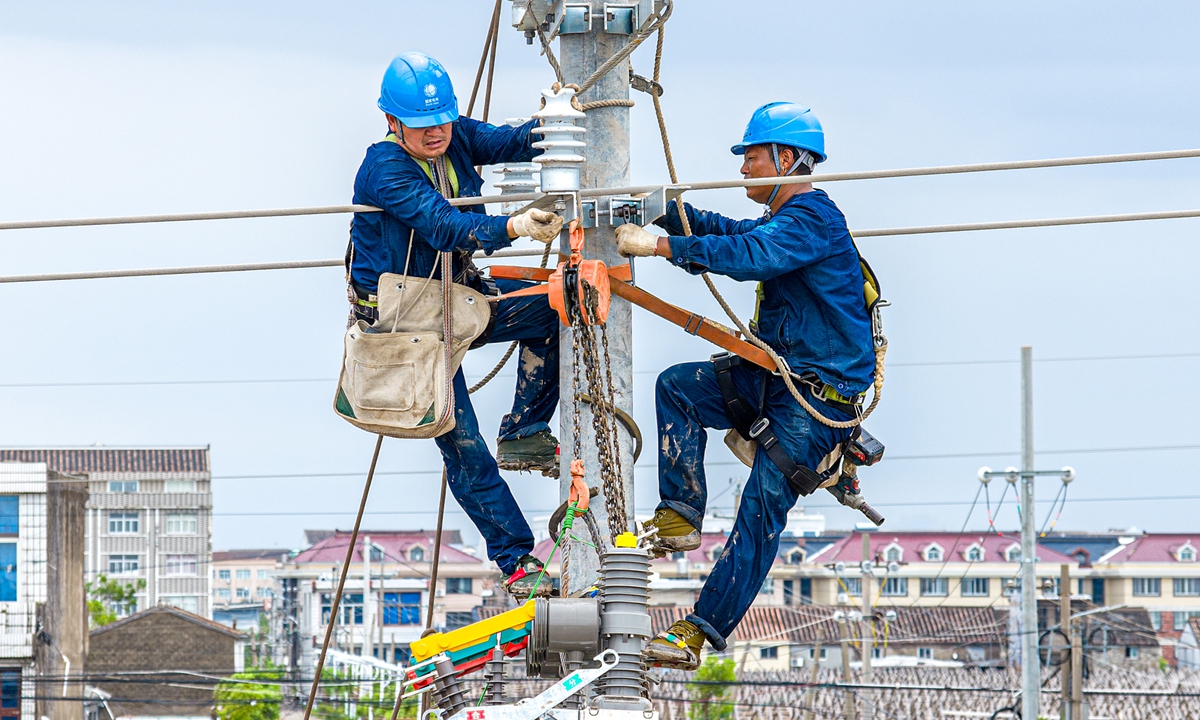
After Typhoon Dolphin, one of the most powerful tropical cyclones to hit China this year, made landfall twice in East China's Zhejiang Province on Sunday, bringing torrential rain and strong winds, it weakened into a tropical storm by Monday morning before moving inland.
The typhoon traveled more than 6,000 kilometers before landfall, lasted more than three times as long as a typical typhoon and set a record as the eastern-most typhoon to make landfall in China. It is expected to continue moving northwestward with its extensive cloud system covering much of East China, bringing strong winds and heavy rain to more than a dozen provinces and regions. Extreme rainfall is expected not only near the landfall spot but also along its northward path, chinanews.com reported on Monday.
Affected by Typhoon Dolphin, ferry services along the Yangtze River have been suspended, and traffic restrictions have been imposed along the entire Nanjing section of the river. All 64 ferry services have been suspended, with crews reinforcing mooring lines and maritime authorities deploying additional personnel on standby.
Traffic controls are in effect along the entire Nanjing section of the Yangtze River, with all vessel operations suspended. More than 1,000 vessels and over 7,000 crew members are sheltering, while emergency boats remain on standby for possible incidents. More than 100 high-speed trains at Nanjing South Railway Station have been suspended, while Metro Line S9 is also out of service. Traffic and urban management crews are working to drain accumulated water. Nanjing has also closed outdoor and water-based entertainment facilities at all rated tourist sites and suspended outdoor cultural and tourism activities amid the typhoon.
The Ministry of Finance and the Ministry of Emergency Management urgently allocated 180 million yuan ($26.74 million) in central government disaster relief funds on Monday. Of this amount, 120 million yuan was allocated to support Jiangsu, Zhejiang, Anhui, Fujian and Jiangxi in carrying out emergency flood and typhoon response and disaster relief efforts. The funds will support search and rescue,the relocation of affected residents, emergency measures to eliminate risks and hazards, the investigation and treatment of potential secondary disaster hazards, and repair to damaged homes.
The National Development and Reform Commission urgently allocated 200 million yuan to support Zhejiang in post-typhoon emergency restoration and recovery, focusing on damaged infrastructure like roads and water conservancy, as well as public services such as schools and hospitals, per CCTV News.
Several government departments also jointly activated a Level IV national disaster relief emergency response on Monday after Typhoon Dolphin severely affected Zhejiang. A disaster relief team was sent to the province to assess damage and assist with evacuations, relief efforts and basic necessities, according to CCTV.
Ma Jun, director of the Institute of Public and Environmental Affairs, told the Global Times that as the typhoon moves farther inland and northward, a much broader area in northern China also needs to prepare for heavy rainfall as the typhoon is carrying a significant amount of moisture and is capable of producing intense precipitation.
The typhoon's impacts will extend into central China, with Henan and Shandong potentially seeing significant effects. Later, the storm could even affect the Beijing-Tianjin-Hebei region, Ma said.
According to the National Meteorological Center (NMC), persistent heavy rainfall is expected across regions including Hubei, Henan and Hebei with torrential rain possible in some areas over the next three days. After Thursday, as the typhoon's remnants move northward and interact with cold air, significant rainfall is expected to continue in Beijing, Tianjin, Hebei and Liaoning, chinanews.com reported on Monday.
A Level IV flood-control emergency response has been activated on Monday for Hubei and Shandong, Hebei and Henan provinces due to prospects of typhoon impacts, CCTV reported.
The Ministry of Emergency Management urged affected regions to strengthen geological disaster prevention, clarify responsibilities, enhance interagency coordination and information sharing, and closely monitor rainfall, flooding and geological hazards, according to Xinhua.
Beijing also issued multiple orange alerts for heavy rain, flash flood hazards and urban flooding on Monday. Several districts subsequently issued red alerts for torrential rain. Beijing plans to activate a Level II flood-control emergency response across the city on Tuesday morning, CCTV reported.
。 "Given that energy is the lifeline of modern economies, modern economic growth patterns, there are not that many alternatives available and there are only a few countries that are players in the global energy market. Russia certainly cannot be counted out and Russia cannot be marginalized in the global energy landscape," says Harsh V. Pant, professor of international relations at the King's College London India Institute and director of the strategic studies program at the Observer Research Foundation.,International Energy Agency (IEA) Executive Director Fatih Birol and US Energy Secretary Jennifer Granholm on 12 July urged Indo-Pacific countries at the Sydney Energy Forum to diversify their supply chains for energy and critical minerals to reduce "dependency" on Russia over its special operation in Ukraine, as well as on China.,"At a time when the energy prices are going up and affecting some of the poorest and most vulnerable countries around the world very significantly, I think Asian countries will continue to cooperate with Russia in order to support their economies and their domestic requirements," says Pant.,He explains that dealing with Russia has become an economic imperative at a time of energy crunch given that Moscow is offering discounted oil to a number of countries. Furthermore, maintaining economic relations with Russia is a question of survival and the people's well-being for some Asian nations and countries of the Global South, according to the professor. Under these circumstances it's highly unlikely that they will succumb to the pressure from Washington and sever ties with Russia, he says.,"For political leaders across the world, at a time when economies are just beginning to grow after the long COVID pandemic, they can [not] afford a lack of energy and higher energy prices," Pant stresses.,Russia, Venezuela to Expand Oil Sector Cooperation, Working on Pact to Circumvent Western Sanctions4 July, 11:15 GMT,Anti-Russia Sanctions: India and EU Approaches,To illustrate his point, the professor cites India's approach to Russia's affairs and the Ukraine crisis. New Delhi continues to import energy from Russia despite the US and Europe urging India to join sweeping anti-Russia sanctions.,"What we have seen in the last two months is a gradual, significant increase in what India is buying from Russia when it comes to oil," the professor says. "This is particularly relevant again because Russia has offered India discounted oil and India's economic requirements demand that India continues buying this oil. The challenges facing India's population mean that the Indian leadership has an incentive in continuing to engage with Russia on this question.",At the same time, the European Union's decision to slap sanctions on Russia and slash energy supplies from the country have backfired on Europe's economy, sending fuel prices up and accelerating inflation.,"We have seen how Europe is struggling to reduce its dependence and the kind of costs that it is imposing on Europeans," says Pant. "Most Asian countries would be reluctant to go down that route.",Brussels: Anti-Russia Sanctions Raise Questions About Sustainability of EU's Financial Model 10 June, 08:44 GMT,The disruptions in the supply of crude after the imposition of ban on imports from Russia have given a dramatic boost to energy prices and inflation, echoes Suranjali Tandon, assistant professor at the Delhi-based National Institute of Public Finance and Policy.,"The current inflationary trends are the most serious challenge for policy makers," she says. "Central banks around the world have begun the process of unwinding loose monetary policy… The current inflation rates have led to internal economic strains and as seen in Sri Lanka, a political upheaval. The cooperation between Russia and Asian countries may be economically prudent.",Moreover, major Asian economies – India and China – are ready to absorb crude supplies from Russia rejected by the West, according to her.,At the same time, Washington's plan to force Asian states to join anti-Russia sanctions is fraught with severe risks for the global economy, Tandon warns.,"The ban, if carried out by other Asian economies, will further cut off supplies of refined petroleum and related products," she says. "This could lead to an unmanageable inflationary spiral while depressing global growth.",Lithium, Gold & Rare Earths: How China May Open the Door to New Business Opportunities for Afghans19 August 2021, 08:38 GMT,Are There Alternatives to Russia & China?,According to Tandon, India sets an important precedent for other Asian states by withstanding the US pressure when it comes to energy sanctions against Russia. By doing this, India is defending its internal interests in the first place, the professor underscores.,She hails the idea that single technology or fuel dependence should be avoided. This principle could be applied to Russia, China, or Western countries in a similar way. However, when the West is calling upon Asian nations to shift to wind, solar, and even nuclear power and abandon fossil fuels, it's clear that this shift cannot be done immediately, the professor emphasizes.,Even after the "green" transition, Asian states and the Global South are likely to maintain ties with Russia and China, who have been developing cutting-edge nuclear technologies and mining rare earths needed for producing electric batteries and electronic components.,"Russia's energy supplies will remain globally important," Tandon forecasts. "More importantly, even when this transition does take place the natural resources including minerals used as inputs in renewables will be concentrated in countries like China. China produces 63% of the world’s rare earth elements, including 45% of molybdenum as per IEA, so it's unclear what countries must do to expand alternatives while being under pressure to transition quickly."。
Current article:http://h20lqcv.fanfutaopoulaxiong.pics/07mhswz/20260826/991405.html
Published on:16:09:32
媳妇的美好时代_Random reading
- 08-25单身狗拿不到的奖杯 玩家订婚获PlayStation祝贺
- 08-25Disco Inferno: Tipsy Guest Creates & Resolves Fiery Crisis at Wedding
- 08-25【透视社·民生沸点】一边享受自由一边渴望陪伴......“空巢青年”,何以为“家”?
- 08-25Heatwave fuels surge in self service pet baths, boarding hotels in Chengdu
- 08-20从破产到巨富,初代游资大佬邱宝裕靠短线翻身,如今罕见发声:超短线赚不了大钱
- 08-21记者:波尔图对签下S·希门尼斯充满信心,已获得球员积极表态
- 08-26亚马逊、苹果、微软、戴尔集体宣布涨价 有产品涨约60%
- 08-25贝弗利:76人众将身体在线 对手要感到头疼了
- 08-262025年618什么时候买苹果手机最便宜?国补+618活动优惠iphone16价格再创新低!
- 08-25पिता ने अनहोनी की जताई थी आशंका, 9 दिन से लापता बेटे का शव देख टूटा सब्र का बांध, पुलिस को हटना पड़ा पीछे

不结婚_Active users
- Dhurandhar: Major Mohit Sharma's Family Moves Delhi High Court Seeking Stay on Ranveer Singh's Film
- PriceSeek提醒:2026年1-7月西双版纳天然橡胶加工量同比增长
- 中方在仙宾礁“填海造地”?外交部:菲方造谣
- 清理浅海区碎石
- 县委第六轮巡察工作动员部署会议召开
- [绥中]县委常委会(扩大)会议召开
- 写差评者被“开盒”?真实消费评价不容打压报复,写差评者被“开盒”?真实消费评价不容打压报复
- 手机厂商最委屈时刻:刚到手就被你套上10块钱手机壳
- 京津冀联合发布7项共建计量技术规范
- ED Raid: सौरभ भारद्वाज के पुश्तैनी घर पर 12 घंटे तक खंगाले घोटाले के सबूत, ईडी के हाथ क्या लगा?
- B'desh tops apparel export growth to EU
- 13岁上海女孩靠AI三天赚1.8万 当事人:几乎不懂编程 写作业会分神偷玩手机
- 上半年国内手机出货量超98%支持北斗定位
- 观察|美方宣布对中国电动汽车等产品加征关税,专家:意在展示强硬争取关键选民
- 斯特鲁斯追忆热火总决赛征程:最纯粹的篮球体验
- 7月全社会用电量再次突破万亿千瓦时 创历史新高
- US Lawmakers Urge Gun Manufacturers to Testify After Mass Shootings: Committee
- 【优悦工会】聚焦科学规划 合力优悦发展 ——杭州市天水幼儿园第十二届四次教职工代表大会
刘銮雄太太第三胎_Hottest this week
- 锵锵三人行 copyright
- Some of the content comes from the Internet. If you have any offence, please raise it.